Witness to a momentous moment
25 November 2026
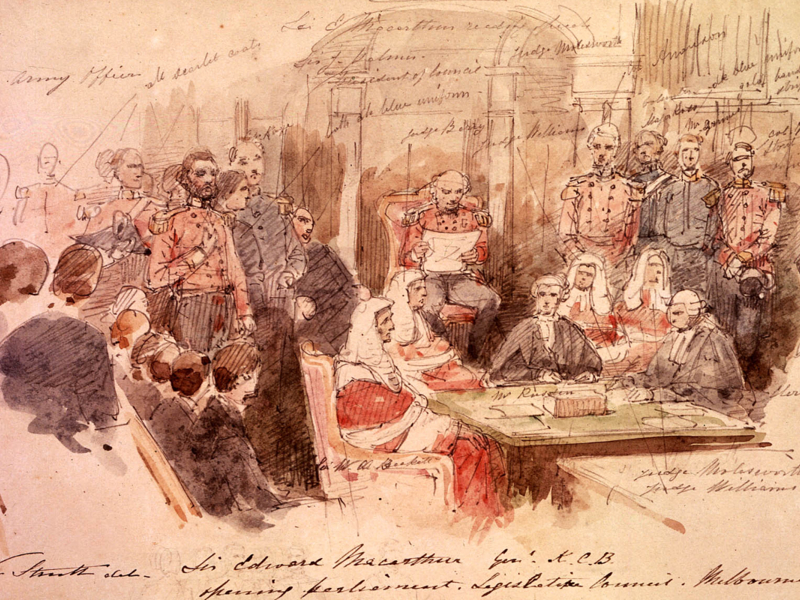
One hundred and seventy years ago, Victorians witnessed a defining moment in our history with the formal opening of our first Parliament charged with the responsibilities of self-government.
The event took place on Tuesday, 25 November 1856 and it was an occasion significant enough to bring much of Melbourne to a standstill.
The day was ‘observed as a holiday in honour of the event’, according to the official record.
Government offices and banks closed at one o’clock, while several large firms followed their example and closed their places of business. A ‘pretty general holiday’ was observed across Melbourne.
The streets surrounding the new Houses of Parliament became the focus of the city.
Traffic in Bourke Street and the streets leading into it was stopped from noon until three o’clock for the ceremonies.
Flags and streamers hung on buildings leading to Parliament House.
Shortly before noon, mounted and foot police had drawn up in front of Parliament House along Spring Street. Then the public began arriving ‘in considerable numbers’.
At half past twelve came a detachment of the 40th Regiment, preceded by its band, followed by members of the Victoria Volunteer Artillery Regiment. The City Council, headed by the Mayor, arrived shortly after one o’clock, while members of both Houses also began to gather.
Then came the signal everyone had been waiting for.
At a quarter to two, a trumpet sounded.
A salute of nineteen guns announced that His Excellency the Acting Governor, Major-General Edward Macarthur, left the government offices. By then, the number of people assembled inside and outside the enclosure and along Bourke and Spring Streets had reached many thousands.
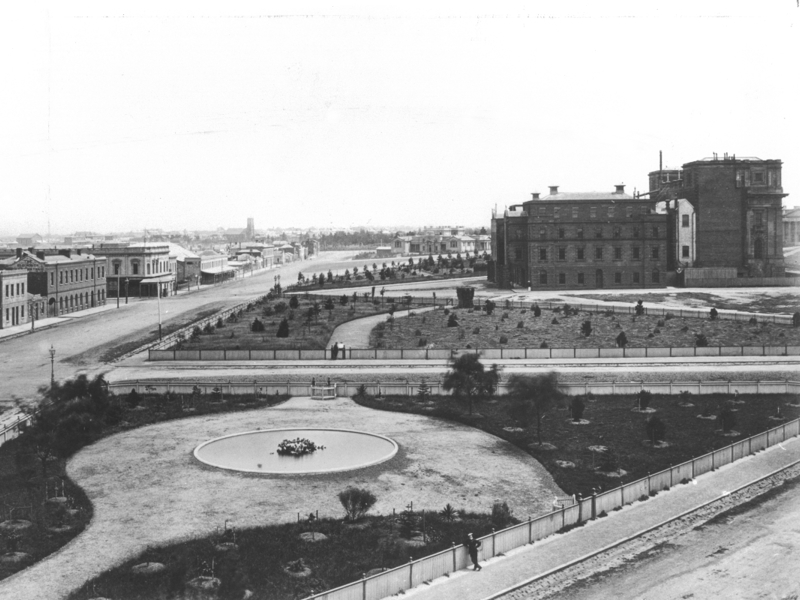
At precisely two o’clock, the Acting Governor reached Parliament House, accompanied by mounted troops. At the entrance, the band played 'God save the Queen'.
The scene inside the Legislative Council was no less striking. The chamber was crowded with people ‘anxious to witness the ceremony’.
Every seat, including in the galleries, appeared to be occupied.
Then came the announcement: ‘His Excellency enters the house.'
The whole assemblage rose. After taking his place in the Council chamber, the Acting Governor directed the Usher to summon the Legislative Assembly. Members entered headed by the Speaker, bringing the two Houses together for the formal opening of Victoria’s first Parliament.
What followed gave the spectacle outside Parliament its deeper meaning.
The Acting Governor described opening the first Parliament of Victoria as an ‘honourable duty’.
His words reflected the magnitude of what had been achieved.
‘I embrace with great satisfaction the opportunity which is afforded to me of congratulating you upon the attainment of the object for which the country has, during many years, struggled - the establishment, in the fullest degree, of the principle of self-government.’
But the speech was not simply celebratory. Self-government came with responsibility.
The Acting Governor expressed confidence that the people of Victoria not only valued their new privilege but were ‘prepared to meet the increase of responsibility which it imposes upon all’. He hoped greater engagement with political affairs would ‘conduce to the happiness and prosperity of the whole community’.
He also reminded the members gathered before him that the new constitutional system was not something to be accepted unquestioningly.
It would be Parliament’s ‘constant duty’ to watch its operation and amend its defects. ‘Every Constitution', he observed, had defects ‘of more or less importance’, and reforms would be necessary to cure them.
One hundred and seventy years later, the historical account captures more than the ceremonial beginning of an institution. Perhaps the most enduring words from that day concern not celebration but responsibility.
The first Parliament was reminded from the outset that self-government required people to value their democratic privileges, engage with political affairs and accept the responsibilities that came with them. Parliament itself was expected to scrutinise and improve the system from which it drew its powers.
This account of the opening of Victoria’s 1st Parliament is adapted from the Hansard of 25 November 1856.